“Narcoterrorist”: The Eventuated War on Drugs/War on Terror Merger Targets Venezuela
PART I: Why the boat strikes in the Caribbean and East Pacific are illegal, and any incursion into Venezuela will be.

Let’s begin with the reaction: the U.N. High Commissioner for Human Rights announced on October 31st, 2025 that U.S. strikes in Caribbean and Eastern Pacific breach international law, amounting to “extrajudicial killing[s]”. At the recent G7 summit in Canada, the EU and France’s representatives pushed back with the same, and the UK has reportedly ceased all regional intelligence sharing to insure no culpability.
Secretary of State/interim National Security Advisor Marco Rubio retorted that he thinks the EU has no say in determining what international law is. In the same interview he alleged the CNN exclusive that the UK ceased intelligence sharing in the Caribbean was a “fake story”. UK foreign secretary Yvette Cooper recovered by issuing a technical evasion, which is as tacit an admission as you are going to get.
A former International Criminal Court (ICC) prosecutor has said that the U.S. naval series of watercraft strikes constitute crimes against humanity (Archive 11/6/25), saying “the military campaign fell into the category of a planned, systematic attack against civilians during peacetime”. The U.S. is not a signatory to the Rome Statute, adhered to by 120 nations. Entering into force in 2002, the ICC deals specifically with individual criminal responsibility for acts such as war crimes, crimes against humanity, and genocide. Under Article 13(b) of the Rome Statute, the U.N. Security Council can refer situations to the ICC for investigation and prosecution, even if the country where the crimes occurred is not a party to the Rome Statute. The U.S. is protected by its veto power in the Security Council.
An Ipsos poll published on November 14th has found that a 55% majority of Americans think the risks of attacking drug cartels in other countries “outweigh the benefits”. According to a YouGov poll concluded September 9th, only 16% of Americans strongly or somewhat support a U.S. military invasion of Venezuela, 6% strongly. A new December 8th poll by Ipsos found 48% of Americans oppose the boat strikes, with 34% supporting. (Archive)
James Story, Ambassador for the Venezuela Affairs Unit (in the U.S. Embassy in Bogota, Colombia), likened the scale of the mobilization to “cooking an egg with a blowtorch“ (more about him). The closure of Venezuelan airspace has been announced, which was a threat aimed at Maduro by Trump to show that negotiation is over and his time window of ultimatum to leave the country with his family is now up. (On Wednesday November 19th, the BBC posted video of Venezuelan President Nicolas Maduro inviting in person peace negotiations, three days after Trump publicly declared to press he was willing to talk.) Encroachment forays recently escalated to piracy and a subsequent naval blockade, illegally predicated on unilateral sanctions. We now have the illegal kidnapping of Maduro on January 3rd, 2026 to address (this was originally published on December 18th), but since the applicable legal analysis is already provided in Part I (even on the matter of it being an illegal kidnapping because an invasion to perform an arrest is illegal), you only need to read the following.
Vulture former Special Representative to Venezuela, Elliott Abrams came circling, in need of more carrion. (The U.S. trained the perpetrators of the massacre(s) in El Salvador and had an advisor present for the worst of those; Eliott Abrams deliberately ran cover for it. (Archive)) The swamp surfaced for air to throw spaghetti at the wall (”he’s good friends with Hezbollah, they’re giving uranium to Hamas and to Iran and to North Korea and to Cuba and to Nicaragua” (6:18) isn’t plausible for a comedic Back to the Future script pitch), while saying the quiet part out loud, celebrating illegal coercion using the illegal use of force for the daylight robbery of oil. (3:10) It’s like having a wing man spouting insanity to normalize your concoctions as a contrivance. (The tune (and the players) do not change.)
The attacks were presaged by Marco Rubio’s state department designating Tren de Aragua a foreign terrorist organization on February 20th, along with a series of gangs and cartels. Cartel de los Soles was designated a foreign terrorist organization on November 24th. Though it’s remiss to point this out, since this gaffe was plausibly fielded on YouTube and it is a false perception supporting this conflict, designating a “foreign terrorist organization” does not automatically make its members “combatants” or “unlawful combatants” (see Question 5). Combatants are defined by the Laws of Armed Conflict (LOAC), also called International Humanitarian Law (IHL), and you have to be legally be at war for those statutes to apply. The only authority the foreign terrorist designation grants is the latitude to pursue sanctions under the International Emergency Economic Powers Act (IEEPA), plus making members inadmissible to the U.S., and deportable under the Immigration and Nationality Act (INA). No amount of vitriolic atrocity propaganda describing criminality alters reality.
The first alleged Tren de Aragua “narco-terrorist” boat was destroyed by the U.S. Navy with 11 killed on September 2, 2025. As of December 31, 2025, at least 115 people have been killed in 35 strikes on 36 vessels, which is distributed as 11 vessels in the Caribbean Sea, 23 in the Eastern Pacific, wiith the latter 2 being in an unspecified location.. Some information is beginning to trickle out about the victims.
It was lately reported that Hegseth issued a “kill them all” command for that first strike that amounted to “show no quarter” by killing men in the water once the boat was already bombed. That two missiles were launched in the strike on survivors was already long reported by The Intercept, and already asserted as a war crime. (It has been correctly enumerated as four strikes in total.) “[Rand] Paul first criticized the attack in a back-and-forth with Vice President JD Vance on social media. Vance responded to the suggestion that the strike was a war crime by writing on X, ‘I don’t give a shit what you call it.’” In actual fact had it just been a single strike it already was, by Rubio’s description of the intentional decision to blow up rather than disable and interdict a boat that wasn’t attacking a naval ship, a war crime, by breaking the principle of necessity. That’s even if this engagement is a war.
According to Wapo: “The commander overseeing the operation from [the recently made infamous] Fort Bragg in North Carolina [involved in at least 24 unsolved murders in four years], Adm. Frank M. “Mitch” Bradley, told people on the secure conference call that the survivors were still legitimate targets because they could theoretically call other traffickers to retrieve them and their cargo, according to two people. He ordered the second strike to fulfill Hegseth’s directive that everyone must be killed.” (Archive) Trump and Hegseth immediately opted to throw Adm. Bradley under the bus, incentivized by the Former JAGs Working Group issuing a thoroughly indicting statement, which coupled with the reporting at long last mobilized the Senate and House Armed Services Committees to investigate. Adm. Bradley appeared before a closed-door, classified bipartisan congressional briefing on 12/4/25. From the closed door hearing, Sen. Tom Cotton asserted there was no “kill them all” order. The secret OLC (Office of Legal Counsel, U.S. Department of Justice) memo that purports to be the legal opinion justifying these strikes, which will be addressed in the following to the extent that anything has been revealed about it, clarifies exactly why it is possible there would be some variance about this or may not have been uttered. From what’s been reported, the technical evasion the OLC memo provides in no way creates plausible legal standing for these strikes.
According to the Former JAGs Working Group: “Regardless of whether the US is involved in an armed conflict, law enforcement operations, or any other application of military force, international and domestic US law prohibit the intentional targeting of defenseless persons,” said the former military lawyers. “If the Washington Post and CNN reports are true, the two survivors of the September, 2 2025 US attack against a vessel carrying 11 persons were rendered unable to continue their mission when US military forces significantly damaged the vessel carrying them. Under such circumstances, not only does international law prohibit targeting these survivors, but it also requires the attacking force to protect, rescue, and, if applicable, treat them as prisoners of war. Violations of these obligations are war crimes, murder, or both. There are no other options.” To give a sense of how glaringly obvious this is, it’s in the DoD’s Law of War Manual as an example of a clearly illegal order, (just like the deliberate attack and murder of civilians is illegal, to point out how glaringly obvious this is).
Ryan Goodman is the Co-editor-in-chief of Just Security, which has been reviewing the legality of the boat strikes since September 3rd. I’ve only seen its credentialed members being interviewed by MSM in a little over past week, and when news broke of the OLC memo. What there has been virtually no reportage about this entire time, as Ryan Goodman just reiterated, is that the U.S. is not, although it’s asserted, in a “non-international armed conflict”. The engagement doesn’t legally qualify. They agree with the UN High Commissioner that these are extrajudicial killings. That means the entire chain of command has been ordered to commit murder, and they are vulnerable to prosecution. MSM was awash with potential war crime coverage, while the same author from the Former JAGs Working Group who published the applicable war crimes statutes stated they are not legally applicable on the same day. (JAG stands for Judge Advocate General’s Corps, meaning military lawyers.)
(The Intercept is not ignoring what authors from Just Security are saying (neither is Al Jazeera), and the broader question of whether the U.S. is legally at war aired in interviews after Adm. Bradley’s closed briefing to Congress on CNN and CBS. (CNN laudably asked Tom Cotton rhetorically whether it’s illegal to just blow up drug traffickers in a boat on a domestic lake and questioned where the congressional Authorization for Use of Military Force (AUMF) is. Fox apparently managed to turn up the most craven former JAG in the nation. (10:20 and 12:33) He got extra-legally creative, asserting drugs were “weapons of mass destruction”. This buffoonery was made official by the president on December 15th.) The subject in being broached has been awash under the potential war crime coverage, with next to no coverage addressing the questionable legality overall since the strikes began, which is an enormous failure in due diligence. Where this has been sparsely alleged no one provides the basis for why it’s illegal.)
The same day Wapo reported the “kill them all” order, it was reported Trump announced he’ll pardon former Honduran President Juan Orlando Hernandez who was sentenced to 45 years in federal prison for drug trafficking 400 tonnes of cocaine to the U.S. “According to Schlenker, Hernández paid D.C. lobbying group BGR Group, which was a leading donor to now Secretary of State Marco Rubio’s 2016 presidential campaign, over $600,000 in 2019 to win allies in Washington as he was under investigation. [...] “Rubio, for his part, has long sung Hernández’s praises, thanking him for his work targeting drug trafficking”.
Shortly preceding Wapo’s revelation about the first boat September 2nd boat strike, there was some folderoh about this video on X, with six Democratic congressional representatives and senators giving an open call to military service members that they can disobey illegal orders. The UCMJ (Uniform Code of Military Justice) subjects military service members only to lawful orders, (and their oath is to the Constitution), though the presumption that orders are lawful means the burden is on the service member to prove otherwise, even though they are the ones legally liable if they follow an unlawful order. The onus is on them to disregard illegal orders. Being clear on the law isn’t seditious. The video was diversionary and pre-emptive in the sense that Trump has not dispatched the military to cities (and that was what it was pointing to), though he suggested it at Quantico. (11:45) What is glaringly illegal in the meantime is staring everyone in the face. Senator Mark Kelly has been threatened with prosecution by military tribunal under the UCMJ (and more, incorrectly). If Kelly is prosecuted, it seems unlikely to open the can of exactly how Trump’s orders as Commander in Chief are illegal; Kelly only has to demonstrate the statement was lawful, and it has no potential impact on the chain of command unless military orders are indeed unlawful.
Kelly is obviously hedging on the recent news (3:09), but there is probably an underlying reason for that other than just worriment about legally inveigling himself. The real reason to evade an affirmative is because Hegseth cannot commit a war crime if the U.S. is not legally at war, and to engage exclusively in a war crime investigation is predicated on the wrongful assumption the U.S. is at war. Gulling public sentiment into demanding the chain of command be investigated for a possible war crime is likely just an underhanded way to manufacture public consent for this conflict. A narrow investigation within these confines on the part of legislators is performative moral outrage with zero risk, in fact it’s public deception designed to solidify in everyone’s minds the legal falsehood that the U.S. is in a war, using the only possible way to get the general public to fall for it. Do not fall for it. The investigation should be whether it’s murder. (We seem to forget who Trump’s mentor was.)
Even were there no escalation past this point, we are witnessing forced encroachment on a nation’s sovereign affairs achieved by unprecedented bullying on a hemispheric scale, fulminating in the illegal dispatch of the world’s most powerfully invested military (third largest standing army), unleashed on a torrent of falsehoods and falsification of pretext, an escalation of engagement so utterly brazen it will have incredibly destabilizing ramifications. The precedent ought to be assessed and preserved for posterity, besides it looks like the U.S. mobilization in the Caribbean is there to stay. Hegseth said the strikes are only beginning, with another strike on December 5th. Let’s review the geopolitical escalation and determine why the U.S. naval attacks on seafaring small craft in the Caribbean, the threat posturing towards Venezuela (and attacks in the Pacific), are flagrantly illegal. (There will be a cul de sac but that is the purpose and it is a purposeful one.)
On September 12th the Pentagon announced they would be reviewing all service member and Pentagon civilian social media posts (Archive) for any negative responses to Charlie Kirk’s shooting. (These posts were private, nor was was this incendiary in any way.) Kirk wasn’t in government. Given he was vocationally a political activist in partisan servitude to Trump with inherently polarizing positions, including the real time denial of genocide, war crimes and the use of starvation as a weapon of “war”, this military purge wasn’t simply political. It was disguised under the pretext that celebrating the killing of an American citizen is unsanctionable sedition level hate speech, (for a killing unverified as a political assassination given the apolitical orientation of the alleged lone shooter, though of course it was hyperbolically asserted). Kirk issued repeated denials of already verified facts which had established the International Court of Justice’s (ICJ’s) prosecution of the genocide case against Israel currently being adjudicated, (a genocide subsequently attested as such by the preeminent international body, the United Nations Human Rights Council Commission of Inquiry, and prior to them, by the International Association of Genocide Scholars, Amnesty International, plus a collaborative report by Israeli human rights organization B’tselem).
There is not even official opprobrium towards sitting Republican congress members who openly advocate war crimes, genocide (including the Chair of the Foreign Affairs Committee Rep.Brian Mast (R-Fla), who wore his IDF uniform to Congress, also a non-issue), and openly celebrate the indiscriminate bombing of babies, the murders of American citizens engaged in peaceful protest by a foreign military, the bombing of American press, and threaten and slander members of Congress. For the temerity to mention this out loud, Secretary of State Marco Rubio (Question 11) and Congressman Randy Fine (R-Fla) will try to get you designated as a terrorist organization. (The swamp is out for you, too. Florida Governor Ron de Santis has already designated CAIR a foreign terrorist organization. By the administration’s logic, were this a federal declaration, arguably the next question would be if that automatically designates them combatants and whether that grants the latitude to execute members on the streets.) Fine denied frothing for the blood of animals to flow in Gaza, but disparaging that they also lived in Florida was an obvious tell. (Hamas doesn’t exist in Florida, Americans of Palestinian descent do (when they’re not being held by the IDF as minors), plus Fine labels any opposition Hamas.) -Welcome to Florida, where, like the White House (and Congress), you will be feted, hosted as speaker even with an existing arrest warrant by the ICC for prosecuting a war (using starvation) against civilians, with a 2024 UN report surveying that 44% of the dead were children (which they could only state below requisite atrocity propaganda falsely alleging sexual violence on 7/10).
For his part, Sec. Marco Rubio has repeatedly sanctioned the ICC (Archive) for prosecuting Netanyahu and Gallant for war crimes, sanctioned the UN Special Rapporteur on Human Rights for the Occupied Territories the moment she implicated multinational corporations and U.S. big tech as criminally complicit (Archive), and further sanctioned Palestinian human rights groups for submitting evidence to the ICC. One of these, the Palestinian Center for Human Rights (PCHR) recently substantiated the use of dogs to rape prisoners. (Archive) (In craven obeisance, YouTube removed the channels of the three Palestinian human rights groups without notice, in excess of the sanction requirements, eliminating over 700 videos documenting war crimes.)
Not only did Rubio act to protect grotesqueries like this from prosecution, Rep.Brian Mast was responsible for the bill that attempted to give Sec. Rubio arbitrary power to revoke U.S. passports, which given Rubio already weaponized the State Department in violation of the First Amendment by the mass revocation of student visas targeting non-citizens for deportation who criticized Israel’s genocidal actions or voiced support for Palestinians’ legally enshrined rights, (working with equally indicted Secretary of Homeland Security Kristi Noem, with Noem deploying ICE to arrest a student for deportation over an oped in a student newspaper supporting BDS), meant Rubio was likewise out to attack Americans’ constitutional rights and violate the Constitution the military is sworn by oath to serve and protect, on behalf of a foreign country indicted for genocide. (The First Amendment protects the free speech rights of persons, not just citizens, making Noem’s and Rubio’s actions against student protesters an incontrovertible violation of the U.S. Constitution.)
Beyond being proven partisan by the glaring political double standard as per endorsing or celebrating political violence (by sanctioning the ultimate form of criminal political violence (re genocide), and violating the Constitution to attack its opponents), the can’t comment anything negative on the event of Kirk’s death on social media firing pretext provided a government wide military industrial complex cull not just of outlying overt Trump opponents venting out of opposition to things like overt racism (however appropriately or inappropriately), it could have impacted disgruntled Pentagon and military service members deriding Kirk because they opposed the maximum war crime of genocide (among others), meaning it potentially encompassed those exercising some modicum of impartiality on the subject in the vocation where it matters most (though it was likely trifling in comparison to the cull the right exacted on teachers).
That the social media sweep was a partisan weaponization against speech was reflected by the Pentagon press secretary (using a survey which makes the American Revolution by her own words an unsanctionable “evil”), conveniently aided and abetted by the removal of a National Institute of Justice (NIJ) study within 24 hours of Kirk’s death demonstrating that since 1990, the far right was much more responsible for politically motivated violence in terms of criminal aggression and mortality. The juxtaposition was designed to implement the graduation to policing speech on one side of the political aisle by equating certain belief systems with terrorism, policing ideology rather than insurrectionist activities or violence, with Sec. Rubio first at the helm to put it to use, (that we know of, because the domestic implementations are secret).
On September 30th came Hegseth’s unprecedented publicly broadcast speech in front of 800 generals and admirals at the Marine Corps Base Quantico in Virginia, where he announced there would be “[n]o more politically correct and overbearing rules of engagement”, after iterating that “if the words I’m speaking today are making your heart sink, then you should do the honorable thing and resign”. Although named firings were mentioned in Hegseth’s Quantico speech, the February 24th removal of three judge advocates general (JAGs) were not among them. Hegseth asserted they presented “roadblocks to orders that are given by a commander in chief“. The Intercept reported that Trump “commissioned his personal lawyer, Timothy Parlatore, as a Navy JAG and empowered him to help overhaul the JAG Corps“ the following month, and that a second Rear Admiral, Head of Naval Special Warfare Command, was likely fired by Hegseth for contending the impending attacks on civilians.
Given JAGs are the legal overseers of the rules of engagement in the initiation of a war and armed conflict situations, and all of these events (and more) were privy to this audience, the signals had already been sent, especially given Hegseth had announced he would be reducing the 4 star generals’ staff by one in five in May. It has now been revealed that “the senior judge advocate general, or JAG in military parlance, at U.S. Southern Command in Miami, raised his legal concerns in August.”
Another signal was sent in 2019 when Trump pardoned two military personnel for war crimes (one whose case was still being adjudicated), and reinstated the rank of another, Eddie Gallagher, “a Navy SEAL accused of first-degree murder in the death of a captured ISIS fighter as well as the attempted murder of civilians in Iraq”. The same Intercept report with the aforementioned quote stated that Timothy Parlatore had successfully defended Eddie Gallagher. Trump’s pardon and reinstatement of all three was because of Hegseth.
It does make more considered what Hegseth’s parameters might be to changing the “retention of adverse information on personnel records”, what sort of infractions will now be forgivable, what sort of climate might ensue when there are no anonymous or repeat complaints permitted, and what sort of relaxation of policies as per bullying and hazing there will be. Would it go so far as to impact the UCMJ governing U.S. military conduct by relaxing rules of engagement (ROE)? Hegseth’s speech was a curious juxtapose between raised standards on appearance/physicality (a troop performance lecture befitting a major to 800 generals and admirals), versus lowered standards and thresholds in terms of actual conduct and ROE, press released with the backdrop of a pronounced partisan chill on what service members and Pentagon civilian staff are allowed to publicly say politically without losing their careers (which extends to opprobrium of Israel). There was no need for disambiguation as to how far up the chain of command Hegseth meant changing the rules of engagement, Trump identified the naval boat attacks as abandoning political correctness (0:53, 10/15/25), expressly rejecting the lawful method of criminal interdiction, arrest and prosecution when it came to drug trafficking, meaning that ROE were abandoned at the nation state level by the Commander in Chief. The following day, U.S. Southern Command Head Admiral Alvin Holsey’s retirement was announced by Pete Hegseth on X. (The resignation date will be December 12, 2025.) A Wall Street Journal report on 12/4/25 disclosed that Hegseth and Holsey were at odds for months over the “murky legal authority” for the boat bombing campaign and that Hegseth was displeased with him not drawing up plans to “reclaim” the Panama Canal.
Signalling had also already been sent when it came to press censorship, a more far reaching censure on what military personnel or Pentagon staff may say. On September 19th, (as a Daily Wire exclusive), Hegseth announced that all Pentagon communication for public release by personnel must be authorized by the Pentagon (including unclassified information), and that no press members could frequent the Pentagon without a badge pass, reserving the right to vet all reporters’ access on whether they were deemed a “security or safety risk”, (a marked up shift from badge access restrictions announced in May). In order to obtain the badge, all press members would have to sign a pledge to only obtain and release authorized information, a badge that could only be retained by compliance, which would encompass lines of questioning. Two days after Hegseth’s Quantico speech, a draft memo (and a second document) by Deputy Defense Secretary Steve Feinberg were obtained by The Washington Post (Archive, 10/2/25), mandating strict NDAs and random polygraph tests for military service members (they could contest this under the UCMJ), civilian employees and contract workers, to prevent leaks from the Pentagon (over 5000 personnel), a reassertion (Archive, 7/6/25) of this technique transformed into war department wide policy. (Polygraphs were used (very impolitely) over a leak probe in March.)
(That same month, the Department of Justice launched an investigation the day following a March 20th New York Times report (Archive) of a combined “intelligence agencies” leaked document dated February 26th that asserted Tren de Aragua was unconnected to the Maduro administration. (Deputy Attorney General Todd Blanche labeled the disclosure “false information”.) According to The New York Times, only the FBI asserted a connection. (Archive) The NIC, the NSA and the CIA reported the opposite. (On September 9th the Director of National Intelligence, Tulsi Gabbard retracted the NSA report. (NYT Archive)) The NYT May 5th publishing of the declassified April 7th NIC memo ran counter to Sec. Marco Rubio’s assertion on May 2nd that Tren de Aragua worked under the direction of Cartel de los Soles, headed by Venezuelan President Nicolas Maduro, and that other Venezuelan leaders direct Tren de Aragua, an attempt to recover credibility by a slight shift in attribution which still conflicted with the report (Archive). According to Axios on May 14, Tulsi Gabbard fired (Archive) the National Intelligence Council’s (NIC’s) two top officials over the leak. “’These Biden holdovers were dismissed because they politicized intelligence,’ said Gabbard’s deputy chief of staff, Alexa Henning, on X.” Gabbard asserted they were fired over the leak. The NIC declassified memo had been subject to two revision processes (NYT Archive) in the attempt to harmonize it with Trump’s statements implicating Maduro as directing and collaborating with Tren de Aragua. Further complicating matters, Trump’s invocation of the Alien Enemies Act to deport alleged Tren de Aragua gang members was contingent on being in a declared war with that country (and inherently its citizens) or being subject to an invasion of U.S. territory by that country, which was why it was struck down by appeals court.)
All news outlets except one rejected Hegseth’s press censorship mandate and walked out of the Pentagon when Hegseth’s press guidelines came into effect on October 15th, the same day Trump equated blowing up boats with not being politically correct. Ultra-Zionist (Shillman Fellow since 2017), self-professed “proud Islamophobe” and Trump whisperer Laura Loomer (who appears to have the ability to make Sec. Rubio bark on command (Archive), in fact he exceeded her demands twice over), along with a smattering of similar right wing influencers labeled independent press were given their offices in the Pentagon. Loomer found the swamp to be her natural habitat.
The swamp seems like the perfect growth medium for the fecundity of toxic ideologues of such zealous overreach it inverts to harm their own country, only exceeded by their hypocrisy. Wielding foreign policy to service ideological conformism has become blunter and less effective than pinata bashing. Trump is engaging in foreign election interference ideologism to the tune of a $40 billion bail out for Javier Milei, an Israel First, “anarcho-capitalist” ideologue who changed land laws to provide opportunistic haven to former IDF war criminals, and ratified a reciprocal social security agreement (which will provide pensions for Israelis not even living in Argentina, largesse obtained by cutting Argentinian pensions 30% and starving pensioners to death), plus privatizing over half of Argentinian water for the Israeli water corporation, Mekorot, responsible for the Occupied Territories’ water theft apartheid system. Trump likewise obliterated his “drug war” pretext for bombing boats as part of his election interference in Honduras.
(Hegseth was arguably hired on the basis of fundamentalist ideology more than any other attribute, hinging on Christian Zionism (which is so rarefied a minority in Christendom it isn’t denominational, but arrived as a political force with the election of Ronald Reagan.)
Rubio’s foreign policy diktat is purely ideological (even to the exclusion of economic interests (Archive)), using the U.S. military to act out childhood fantasy he boasted to his indoctrinating grandfather. (The regime change of Venezuela leads to the same for Cuba in their inverted domino theory, actually it’s a “troika of tyranny” with Nicaragua as the third target.) This traipse down memory lane from Wapo has Rubio proximately at age ten crediting Reagan with “restoring the military”, when he had been in office a year or less. (Nicaragua and Afghanistan were just beginning to be in play, there was the initiation of a mass military build up, and the election steal operation dubbed the October Surprise. (Archive)) It should have been delved to what extent the unconditional support of the Contras by Reagan was related to Rubio by his grandfather as laudatory, and where Rubio himself stood on the matter given that when the Iran-Contra scandal broke (it should be mentioned in light of what follows by a Lebanese newspaper), he would have been the discretionary age of fifteen. (The Wapo piece is explicit the grandfather advocated for Reagan’s “controversial” support of the Contras, and was Rubio’s political mentor.) Given the nature of Reagan’s support, Rubio was imbued with the understanding that the CIA orchestrated Contra proxy war in Nicaragua was virtuous American exceptionalism at work, using members of the weaponized (post Bay of Pigs militarily trained) U.S. Cuban diaspora as troops and advisors (they were involved as the CIA themselves), which could hardly have been an unknown to the Miami Cuban community, surely framed as freedom fighters despite the fact that the Contra human rights record was ghastly enough for Congress to terminate funding. Elements in Reagan’s administration illegally circumvented this termination, resorting to secret illegal arms trade with embargoed adversary Iran via Israel for funding, compounded by arms for cocaine financing directly implicated in the domestic crack cocaine epidemic. Wapo’s “controversial” euphemism is doing quite the heavy lifting, concealing ideologism so aberrant it asserted abrogation of U.S. democratic governance at the expense of human rights, both foreign and domestic, on the overweening profundity that fighting for “values” was “worth it”, ideologism for ideologism’s sake unleashed in a proxy reign of terror. (After 1977, Israel became the intermediary to arm, provide intelligence and counterinsurgency training to the government ideological proxy deemed too genocidal (to the tune of 200,000 nearly all Mayans) in Guatemala.) The Reagan administration did little militarily beyond these Central American covert interventions (and/or death squad trainings that Elliott Abrams was the point man for) in El Salvador, Nicaragua, Honduras and Guatemala. (Little that is apart from getting nearly 250 U.S. marines blown up in Lebanon, equally bloody proxy forays in Africa (Angola and Mozambique, plus support for the South African apartheid regime), and the false flag predicated bombing attack on Libya in 1986.) It begs the question what Rubio and his grandfather found so admirable militarily about Reagan, given the only actual military invasion was Grenada, and such a stance occluded the mass killing and torture of Central American civilians (and many more). Members of the Cuban diaspora (and other Latin Americans) served all too willingly in order to forward their ideologically driven invasion interests, which granted them inordinate political clout (Archive); -the Cubans still identified as an exile community generations in. (Rubio mythologized accordingly.) It’s not clear whether Rubio’s grandfather presented moral inversion mandated by exceptionalism so exclusive the ends justified all means, hallowed as sanctionable in terms of the Reagan administration’s violation of the law; (Rubio could have already been instilled with the upbringing to arrive at that assumption himself; -such sparse reportage omits whether the political orientation was all inclusive, for obvious reasons.) Given the deep political commitment engendered by the direct military involvement of community members, it’s not like the broader community would have withdrawn support or pulled endorsement when Congress pulled the plug.
Proximate to Reagan’s one of three military interventions involving boots on the ground, Osama bin Laden was an eyewitness to the Israeli (same MO ultimately civilian) bombing of west Beirut (followed by the Sabra and Shatila massacre) in 1982, which set his life path. It was the point of place where he came to view Israel/US as an equal offender axis, identifying the US as a “crusader” force. (Reagan briefly put in, then withdrew the boots on the ground, (which was the window wherein the massacre took place). The suicide bombing came after they were brought them back in. Bin Laden concluded the “success” at the marine barracks meant that the U.S. could be repelled, giving the bungled operation truly epochal scope. The perceived enabling of the Israeli invasion of Lebanon by the weak attempt to perform on the ground management of savagery (as opposed to any material upbraiding such as threatening the withdrawal of largesse), coupled with the diametric unleashing of Islamic fundamentalist proxy warfare in Afghanistan which harnessed bin Laden/Al Qaeda as an asset (granted Operation Cyclone was launched by Brzezinski under Carter in 1979; it was carried out under Reagan), plus the use of weaponized immigrants and trans-national foreigners in (or to run) CIA gestated proxy paramilitaries and death squads, -let’s just say that the inextricably conflicted policies that Reagan loosed are entirely still with us, now erupting in full. The Reagan Doctrine was a shift from invasive to proxy warfare framed on ideological grounds; its execution in defiance of Congress an act of preeminence predicating that ideology overrode the Constitution and the law (with no question or regard concerning the descent into depravity of the body count).
It could not be more fully expressed than it is in Rubio. We may not know what level of ignorance Rubio was raised with, what’s striking is that he reads as if he was raised exactly this way, blithely unconcerned with all the deadly corollaries churned out by Reagan’s doctrine, even encompassing sponsoring the legislation that deliberately hamstrung the DEA’s ability to avert the domestic carnage of another induced drug crisis by preventing their ability to halt white collar obviously ciminal distribution overseen by three major distributors; he was paid well; (given the unanimity so were they all). Rubio already has a demonstrable foreign policy track record of established entente with heads of state implicated or immediately convicted post tenure for massive drug trafficking operations on (at least) two counts. (His personal intervention signals he doesn’t take drug trafficking all that seriously as a crime when it’s close to home.)
Given his own culpability in the pharmaceutical opioid OD deaths of an unquantifiable number of Americans after the above legislation in 2016, his weaponization of drug trafficking is pure political exigency exercised in the interest of his own personal ideological military conquest. (Pull up a graph of the three wave opioid crisis in terms of mortality, see where 2016 falls, and register how the pharmaceutical opioid OD death rate got to keep holding steady a while longer. The prolonged duration of the crisis greatly increasing the addicted “market” for the two succeeding opioid OD mortality waves of heroin and fentanyl in terms of continuing to create a growing number of addicted overall (which wasn’t quantified; a great many were eventually forced to off-ramp into illicit opioid abuse), creating a massive addiction market caused by the complete institutional collapse into greed and untrammeled corruption, which outrageously prolonged the pharmaceutical opioid addiction wave. It was launched on egregious private fraud and public deception for profit helmed by the Sackler family with Oxycontin in 1996, creating the largest addicted prey market ever delivered to wholesale predation by illicit opioids arguably in history, (apart from the Opium Wars). The exponential fentanyl death rate is a product of its deadliness; OD deaths provide no indicator of addiction rates. From 2008-2013 pharmaceutical opioid prescriptions exceeded the number of adults in America, pure unbridled profit. Prescription fentanyl was one of these, and the one most criminally promoted (Insys/Subsys). Alex Gibney rightfully dubbed his documentary on this “The Crime of the Century”. It was 100% self-inflicted. Nothing did more to compound the damage than the open complicity of the revolving door from enforcement to legal advocacy (the former DEA lawyer turned pharmaceutical attorney who authored the bill in particular), lobbyists, complicit legislators and the deep sixing of the most key prosecution within the U.S. court system, plus fines so minimal in sentencing it was ratioed by profits to the point of burying the penalties in the cost benefit analysis, putting (an exceedingly high) profit margin squarely on the side of criminality. (In other words, so long as addicting the American population to opioids illegally benefited the domestic oligarchy it was fine for it to be prolonged as much as possible.) While all of this was deadly complicity, nothing went so far as deliberately preventing the DEA from preventing deaths they’d already determined were from criminal levels of escalating distribution they’d investigated and regionally documented.
Imagine having direct legislative culpability in prolonging the crisis (and more as a Florida house representative and Florida senator in terms of contributory negligence (the most benign take), “overseeing” the pill mill capital of the country, yet engendering an illegal “war on drugs” against a government your entire political career was dedicated to trying to topple because you loathed their politics, using the weaponization of displaced anguish you were directly contributory to as a legislator, and being capable of not breaking a bead of sweat on the (so diametric it’s attacking itself) failure in moral logic. Secretary Marco Rubio is a walking psychopathology in weaponized denial, consciously unleashing the deliberate displacement of national justified outrage and societal anguish caused by the “Crime of the Century”, reducing it to a mere exercise in societal propaganda, swiveling the crowd mind to his ideological choice of target, just to fulfill his familial political aspirations. Imagine sponsoring legislation stating that “extrajudicial killings perpetrated by the Government of the Philippines as part of a government-directed antidrug campaign present the foremost human rights challenge”, yet proceeding to openly proselytize prosecuting the exact same crime, providing the victims are foreigners executed by the U.S. military, and not internally combusting on that failure of moral logic. That’s smooth sailing on unadulterated ideological exceptionalism.
(It didn’t work out for former Philippines President Rodrigo Duterte.)
In sum the mass death and extrajudicial murder of civilians using occlusion of the realities is now more openly sanctioned than ever. The open hypocrisy is beyond staggering. Thanks to overweening ideology, the U.S. is now on the hook (since ratifying the UN Genocide Convention in after a 40 year delay in 1988), for arming the genocide of an entity it doesn’t even have a military alliance with, in violation of international and domestic laws, an entity that is still starving and burning children alive, committing mass death strikes of civilians by violating the present ceasefire at least 591 times, (killing at least 360 and injuring 922), plus violating the ceasefire with Lebanon over 2740 times. Rubio is willing to violate the Constitution for this; (it pays well); he’ll prosecute a war illegally and violate the Constitution that way too. Make no mistake, this is his oeuvre. Back to the fray.
On October 2nd a Trump confidential memo to Congress announced that the U.S. was in a “non-international armed conflict” with drug cartels and designated targeted individuals as “unlawful combatants”, meaning they are not part of regular armed forces and not subject to Geneva Conventions or international law on war, nor are they protected by civilian laws regarding criminal adjudication and detention, -at least that was how and why the second Bush administration appropriated the term for legal weaponization. In this instance, engaging in criminal activity does not make an individual a combatant, nor does it make an individual a terrorist, which is the unlawful use of violence or the threat of violence as intimidation, particularly against civilians, for political aims. Drug trafficking is not engagement in political violence, nor is it terrorist violence against the general public or state apparatus. Criminal activity in and of itself is not terrorism, although criminal activities can be used to materially support it, which is not the case with Venezuela. “Narco-terrorist” is being brandished in order to pretend a war can be launched on the pretext of criminality.
The open ended “global war on terror” (GWOT) was deeply problematic from a legal standpoint for many reasons. (Its reliance on repeat deployments of special forces as advocated by Elliott Abrams was its own special problem.) It violated the prohibitions in the U.N. Charter on the use of force, bypassed legal frameworks for conflict and detention (e.g., indefinite detention, extraordinary rendition, targeted killings outside recognized war zones), and initiated a U.S. government-sponsored torture program (”enhanced interrogation techniques“). It was completely spurious by legal definition because it was a declaration of war against a tactic (terrorism), not at state actor. It was the first declaration of war that had no national boundaries. The “war on terror” was initiated in September 18, 2001 by an Authorization for Use of Military Force (AUMF), bypassing Congress’s sole constitutional authority to declare war (though they haven’t declared war since WWII). An AUMF is a joint resolution passed by both the House and Senate that gives the President the authority to conduct military operations considered more limited than a war, that is, until AUMF 2001 blew time frame, geography, and with the term “unlawful combatants”, the targeting of potential terrorists, their incarceration and their treatment way too wide open. According to ICRC.org:
“The Bush administration determined that its ‘war on terror’ was neither an international nor a non-international armed conflict because Al-Qaeda was not a State party to the Geneva Conventions and the conflict went beyond the territory of one State. Furthermore, it held that its enemies in the conflict were neither combatants nor civilians but unlawful combatants who could be attacked at any time [outside combat] and detained indefinitely without trial.”
“Non-international armed conflict” is codified in the Geneva Conventions, but Trump’s declaration does not legally qualify, first because it is not taking place on the territory of one of the parties to the Geneva Convention (so far, though the President of Colombia, Gustavo Petro alleged that a boat attack violated Colombian territorial waters), but also:
“Non-governmental groups involved in the conflict must be considered as ‘parties to the conflict’, meaning that they possess organized armed forces. This means for example that these forces have to be under a certain command structure and have the capacity to sustain military operations.” No cartel or gang has the capacity to sustain military operations, nor are they attacking the U.S.. Additionally, “[t]o bring the law of non-state armed conflicts into play, an opposition group would have to displace the central government from exercising effective control over entire parts of its national territory through concerted and sustained military operations”.
The “war on terror” was not only amorphous in terms of being deliberately undefined as an actual war engagement in either category (to deliberately nullify how war engagement has been codified by law), it was ambiguous because there is no international legal definition of terrorism, a term so subjective it has just been abused to the extent of intentional complete mislabeling. The 2001 AUMF’s latitude was so broad that it transmogrified based on its “terror” mandate past the bounds of its declaration against Al Qaeda as the perpetrators of 9-11, into forays against ISIS and other groups. It is still in effect, but can hardly be used as pretext for an engagement against completely unrelated criminal organizations who have never attacked the U.S. or its military personnel abroad.
Under AUMF 2001 Obama drone attacked (with the requisite collateral civilians) Pakistan, Yemen, and Somalia, authorizing extrajudicial killings based on a weekly kill list (including a U.S. citizen and the collateral death of his U.S. citizen son), as well as conducting airstrikes in Syria and Iraq. (The 2002 AUMF authorizing the invasion of Iraq was also applied to these ISIS airstrikes.) All AUMF engagements (and elsewhere) include invocation of Article II of the U.S. Constitution as provision giving the President unilateral authority to initiate hostilities, which is invoked in U.S. war engagements to assert legal precedence over the U.N. Charter (which the U.S. has incorporated as the supreme law of the land, -with the exception that if the U.N. Charter is in a legal conflict with the Constitution, the Constitution overrules the U.N. Charter as a matter of domestic law).
Marco Rubio gave his full-throated support for the Somalia drone strikes’ continuance under Biden under the GWOT AUMF 2001 (against Al Shabaab): “’I don’t think the president needs a law passed by Congress in order to target terrorists who are posing a threat to the United States, no matter where they are in the world,’ said Sen. Marco Rubio (R-Fla.), the vice chair of the Senate Intelligence Committee. ‘Especially if it’s a one-off, targeted engagement, not a full-scale military situation.’”
The U.S. drone strikes in Somalia against Al Shabaab and ISIS are still ongoing, with over 100 strikes during Trump’s term in office. It’s also incredibly specious because Al Shabaab did not even pledge allegiance with Al Qaeda until after U.S. drone strikes on the group began in 2011. (The first U.S. air strike was in 2008.) It was an off shoot of groups rooted in Saudi Wahhabism. Their terrorism attacks also occurred after. (Somalia was on the list of seven countries to invade that were immediately put on the Pentagon agenda post 9-11. The list is nearly finished.) It begs the question how the group posed a threat to the United States. Al Shabaab did not engage in an attack on a U.S. military base until 2020. In any event, foreign bases are on the sovereign territory of foreign countries, meaning the threat of attacks or even invasion of U.S. foreign bases constitute no threat to the sovereignty, territorial integrity or political independence of the United States, the sole attributes of nation states enshrined with legal protection under the U.N. Charter, disqualifying such engagements as a matter of U.S. national security where the law is concerned. The same goes for ISIS engagements.
Given Iran’s missile range, the same goes for Trump’s use of the 2002 AUMF authorizing the Iraq War based on an OLC memo and Article II to pretend to qualify bombing Iran in June 2025, (after considered use of the 2001 AUMF for a future attack of Iran during Trump’s first term was roundly rejected). That’s even if you can qualify Iran being months away from developing a nuclear bomb, which was not the assessment of the Director of National Intelligence, who Trump had to repudiate. The same goes for when AUMF 2002 was used as grounds to assassinate IRGC general Qassem Soleimani in January 2020. In October 2025 the Senate passed another amendment to repeal the 1991 and 2002 Iraq AUMFs as part of the National Defense Authorization Act (NDAA), which now awaits House approval. Likewise no efforts towards repealing the GWOT AUMF 2001 have ever passed. In effect Congress lost their constitutional authority to end a conflict.
Now the “terror” label is being used to effect extrajudicial executions on the high seas absent any presentation or obtainment of evidence, identification or apparent legal rationale. (Democratic congress members were being obstructed by Republican representatives from obtaining testimony from Admiral Hosley on whether he retired because he deemed his military orders to be illegal, as well has being stymied by the non-appearance of Pentagon lawyers who were supposed to provide legal grounds.) The OLC legal opinion the attacks are based on remains classified.
A draft proposal for a far broader AUMF is being floated in the White House and Congress, proposing an endless “war on drugs” using the misnomer “narco-terrorism” would provide, allowing for potential U.S. military engagement with over 60 countries.The Monroe Doctrine, which has been exercised by the U.S. for more than a century since the 1898 invasion of Cuba and Puerto Rico during the Spanish-American War to conduct a series of ongoing military interventions against many nations throughout Central and South America and the Caribbean, will be transformed into an indefinite open military conflict. The doctrine has been resuscitated by Trump and members of his administrations (along with the term Manifest Destiny, significantly in the 2025 inaugural address where Trump announced that the canal treaty was being violated by Panama and threatened to take it back).
The non-existence of legal grounds in terms of either criminal or “war detainee” options for Tump’s “non-international conflict” were thrown into relief by the event of there being two survivors of a submarine attack on October 16, 2025, in the Caribbean Sea, (the same day Admiral Holsey’s retirement was announced), legal issues so obvious they were promptly repatriated. To have a war detainee, you have to legally be at war. This Trump declared “non-international armed conflict” doesn’t even have an AUMF, nor was there authorization by the U.N. Security Council, nor was the U.N General Security Council notified that the U.S. was exercising “self-defense” against the “use of force” as provided by Article 51. Nor, as already iterated, did the engagement meet the legal qualifications for a “non-international armed conflict”. There was no legal basis to hold them as war detainees because there was no legal basis for this declaration of war. Were the administration legally in a “non-international armed conflict”, they would have automatically been held as war detainees. They were not.
It was impossible to hold them as war detainees because while there is a subsequent body of U.S. law concerning “unlawful combatants”, were the executive administration to blindly pursue prosecution as “unlawful combatants” under indefinite detention, they would have a right to legal counsel and trial by a war commission (not a military tribunal), neither of which has the jurisdiction to prosecute criminal domestic law, only violations of the laws of armed conflict, which the U.S. itself is serially violating by extrajudicially executing civilians by blowing up boats, making them the sole offender.
In terms of jurisprudence, because the designation “unlawful combatants” was defined to evacuate the legal definitions of international armed conflict and the legal frameworks pertaining to both combatants and civilians, everything had to be built from the ground up, meaning new prosecutorial legislation adjudicated by new military commissions, codified in U.S. domestic law, i.e., the Military Commissions Act (MCA) of 2006, given prosecutorial authority post September 11, 2001. It was passed in direct response to the Supreme Court’s ruling in Hamdan v. Rumsfeld, and re-ratified with amendment under Obama in 2009, (after a campaign promise to end it and military commissions). Hamdan vs. Rumsfeld ruled that Geneva Convention IV common Article 3 applied to “unlawful combatants” and that the President’s Military Order of November 13, 2001 did not comply with U.S. or international law. The MCA dealt with this by codifying how Article 3 applied to reduce its scope to what were considered “grave breaches”, defining torture, murder, cruel treatment, biological experiments, mutilation or maiming, intentional cause of serious bodily injury, rape, sexual assault or abuse, and the taking of hostages. It eliminated “outrages upon personal dignity, in particular humiliating and degrading treatment”. The agenda was to prevent prosecution of U.S. military personnel who had previously engaged in torture by attenuating the power of the War Crimes Act of 1996, which enshrined the four Geneva Conventions and common Article 3 as domestic law, using the MCA to ban lawsuits using the Geneva Conventions or habeus corpus to subject the U.S. or U.S. personnel to prosecution by private right of action by detainees, giving the President authority to interpret the conventions, and forbidding the use of IHL as a basis for rule of decision in U.S. courts when interpreting the act, confining rulings to only prosecuting the MCA legislation. Nevertheless, had these submarine survivors been subject to prosecution by war commission as war detainees, only the U.S. had prospectively violated the MCA by attacking the defendants as civilians.
The military commissions were replete with issues, e.g., they allowed for detention after acquittal, allowed the introduction of hearsay, issued punishment for actions that were not illegal at the time they were committed, limited the rights of the accused to confront evidence and witnesses, used evidence obtained by torture and ill-treatment, lacked independent review, allowed the use of classified information to restrict the defense, were absent protections against command influence, had issues with the composition of the panel, and as the Omar Khadr prosecution showed, made no distinction between minors and adults; (at least 22 of the Guantanamo detainees were originally children). As iterated, they have no jurisdiction over criminal law. It’s as easy as searching what “war crimes” MCA covers, which are often criminal and otherwise covered by pre-existing war crimes statutes, meaning that the charges being war crimes was a matter of venue not substance. There is a realm of statutes in the MCA that target civilians for materially supporting terrorists, which are defined as war crimes, and can be so simple as a mother providing a meal. Nevertheless, given the legislation was designed to target “terrorism” by “unlawful combatants”, it doesn’t cover criminality. It does cover murder of civilians in “non-international armed conflict” as derived from common Article 3.
With the prospect of proceeding with prosecution of these two survivors as “unlawful combatants” being potentially worse than the inability to admit non-existent prosecutorial authority by prospectively meting the same as manifest outcome(s) via dismissal due to the contention of no jurisdictional authority (not at war) and no applicable statutes, with non-dismissal potentially opening the prospect of litigating the legality of the conflict, and even worse, if prosecution provided vantage into litigation of the U.S.’s flagrant violation of IHL at the most fundamental level of the principle of distinction between civilians and combatants, that forced the considered alternative of arrest and detainment of the survivors under U.S. domestic criminal statutes (unlike a war commission, requiring full due process), throwing into even more glaring relief that these were the sole survivors of extrajudicial execution. It goes without saying if you cannot meet the legal criminal threshold for convicting a drug trafficker, how can you justify summarily executing them when that violates your own criminal laws? Especially given a submarine was obviously more suspect. You can’t if you’ve scuttled the the evidence (the question’s been asked, statement ends at 2:23). There is method to the madness of leaving no survivors.
(The New York Times took nearly two months to report on the implications of the two survivors, deftly avoiding the legal prospects, but depicting the scramble produced by the imperative to keep them out of U.S. prosecution. (Archive) Notably their second go to for comment was Brian Finucane, a former lawyer for the State Department, whose in depth legal analysis is hosted at Just Security. (He’s broached the subject seven times; four are podcasts. He was the first published on September 3rd. NYT grants one sentence of coverage absent any reference over three months later.))
It was worse than that. There was no way to arrest them as war detainees given how the executive branch planned to contend with the 1973 War Powers Resolution, (which provides for AUMFs). Notice was given to Congress within 48 hours, but not in the framework of engaging in “non-international armed conflict”. According to CNN, “[t]he head of the Department of Justice’s powerful Office of Legal Counsel (OLC), T. Elliot Gaiser, told select Senate and House lawmakers on Thursday [10/30/25] that the US strikes on alleged drug boats in the Caribbean Sea and Pacific Ocean did not trigger the law’s requirements because they don’t meet the definition of hostilities”, because there was no return of attack. Meaning the attempt on the part of the administration to play both sides of the fence descended into complete legal conflict, all too obviously wiping out any pretext of self-defense, and completely obliterating any pretext of being in a “non-international armed conflict”, which is predicated on being attacked by a force of military capacity. “Gaiser emphasized the fact that the US military wasn’t being attacked in response to the strikes as part his argument that America was not at war”. It doesn’t get more “Duh“ than this.

To declare the U.S. is not at war is to completely abandon military service members to the risk of prosecution for the murder of civilians. It defaults to existing U.S. statutes and the prosecution of military service members for murder; (Lederman adds that these attacks violate the legislation of the Assassination Ban), but if qualified as a “non-international armed conflict”, U.S. ratified international IHL statutes as per the protection of civilians will apply, whereas domestic military protocols apply either way: “Notably the Commander’s Handbook on the Law of Naval Operations declares unequivocally that ‘[c]ivilians may not be made the object of attack and feasible precautions must be taken to reduce the risk of harm to them.’” Additionally, “the United States agrees that all States are bound throughout the world by customary human rights law, which is ‘considered part of U.S. law’ (Operational Law Handbook at 98, citing, inter alia, The Paquete Habana, 175 U.S. 677 (1900))—and the United States further agrees that the prohibition on murder, reflected in Article 6 of the ICCPR [International Covenant on Civil and Political Rights], is a ‘peremptory norm[] so fundamental and universally accepted’ that it does ‘not permit any derogation, even by treaty’ and ‘bind[s] States during all operations inside and outside a State’s territory’”. “DoD Directive 2311.01 § 1.2(a) confirms the Department of Defense’s longstanding policy that not only must ‘[m]embers of the DoD Components comply with the law of war during all armed conflicts, however characterized,’ but also that ‘[i]n all other military operations, members of the DoD Components will continue to act consistent with the law of war’s fundamental principles and rules, which include…the principle[]…of distinction.’ (The DoD Directive also identifies the prohibitions in Common Article 3 of the 1949 Geneva Conventions and the principles of military necessity, humanity, proportionality, and honor.)”
To provide a legal fig leaf as keystone total collapse into the absurd, according to the secret OLC legal opinion memo this engagement targets the drugs themselves as per a “revenue generating target theory”, claiming the narcotics believed to be on board the boats are the military objective, and that any persons on board are merely collateral damage. The cartels are alleged to be using the drugs to finance military hardware for terror operations, not engaged in extortion and violence to protect their business, in order to profess that they are terrorist organizations, in an attempt to qualify engagement as a ‘non-international armed conflict”, claiming Presidential prerogative under Article II of the Constitution. This is supposed to confer battlefield immunity. Admiral Bradley has confirmed this is the substance of the OLC memo in his closed door bipartisan briefing; “while the survivors were not armed, he said the mission identified the drugs as the threat to the U.S., effectively deeming the cocaine as the weapon that could endanger Americans.” The target is the cargo, with fentanyl identified as a “potential chemical weapons threat“. The rest is semantics; there’s hardly a distinction between being provided with a kill list of all on board vs a “kill them all” order, other than to pretend it’s sanctionable because of Obama. Bradley stated that the boat was not even headed for the U.S. (1:33)
A report from The Guardian confirms and expands on this, saying the OLC memo is “framing its boat strikes against drug cartels in the Caribbean in part as a collective self-defense effort on behalf of US allies in the region” and “that the cartels are waging armed violence against the security forces of allies such as Mexico, and that the violence is financed by cocaine shipments”. As already mentioned, this doesn’t qualify because there are no armed sustained attacks within allied countries involving the identified armed groups with a chain of command capable of conducting military operations, nor have they gained any territorial control. Nor are they presenting any threat, let alone have they attacked, the United States.
“As a result, according to the legal analysis, the strikes are targeting the cocaine, and the deaths of anyone on board should be treated as an enemy casualty or collateral damage if any civilians are killed, rather than murder.”
“Martin Lederman, a former deputy assistant attorney general at OLC during the Obama and Biden administrations, expressed skepticism with the administration’s claims about collective self-defense.
‘A significant problem with this theory is that they still have not identified any state that’s engaged in an armed conflict with a particular cartel,’ said Lederman.
“Nor has the administration provided any evidence that another state engaged in such an armed conflict has asked the US to destroy cocaine shipments that are allegedly being used to subsidize armed violence against the requesting state,’ he said.” Again, we have Lederman from Just Security being quoted in MSM, absent any reference that he is very clear in the above that there is no “non-international armed conflict” and every engaged element of the DoD is culpable or complicit in murder. There is not such thing in this context as an enemy casualty.
As this OLC memo is the legal fix designed to protect the chain of command in the future against the contention they were dispatched to commit murder (domestically Trump needn’t care), the fact that the pretext of self-defense is still a failed contention, and that the memo simply dismisses the murder of civilians as if existing law does not apply, is functionally absurd. Simply put, you cannot claim self defense against an inanimate substance, nor claim it is capable of attack. You cannot claim you are in a “non-international armed conflict” against an inanimate substance. To claim this does not evacuate the rules of engagement, the laws of armed conflict, nor international human rights law. Nor does the claimed designation the drug traffickers are terrorists automatically render them combatants. (The killing of civilians is the first obvious “manifestly illegal” military order on all these military attorney websites for a reason.) It is clear the Trump administration knows the OLC Memo as a functional legal impediment is next to useless. (It’s not like the torture and interrogation OLC memos stood the test, the law caught up with those.) The Trump administration is threatening the ICC with complete sanctions unless it amends its charter to grant Trump and his functionaries prosecutorial immunity.
The engagement also exceeded the legal time limit of hostilities as per the resolution of 60 days, (again CNN), “after which the administration has to either cease the use of military force, [or] get an extension on the clock or a war authorization from Congress [...] Gaiser told lawmakers that the administration does not need to seek an extension of that 60-day clock, which expire[d] on [11/3/25], because the law doesn’t apply in this case”. Per The Washington Post (Archive 11/1/25) “Asked for comment, a senior administration official said the War Powers Resolution did not pertain to the current situation, because, ‘even at its broadest … [it] has been understood to apply to placing U.S. service-members in harm’s way.’” The Trump administration exceeded the time limit on the War Powers Resolution, committing strikes until November 15th, with another strike on December 5th and December 17th, meaning to not violate U.S. domestic law on Congressional authorization to commence a war, this has to not be defined as a war, which is what they asserted. To reiterate, if military service members are not in harm’s way, there is no predication of self defense and no claim of being under attack, and according to the executive, no war, which means these are extrajudicial killings.
In war there are laws of necessity, precaution and proportionality, including the requirement to ensure opponents are not killed when they can be taken prisoner, and regulation of their treatment. Again, Professor Weller: “The US attempt to apply the humanitarian law of armed conflict, only to then deprive the supposed ‘terrorists’ of its protection by branding them as ‘unlawful combatants’ does not persuade.” Such a designation does not automatically evacuate the right to life under human rights law or the right to due process. “Unless they are just about to launch an actual, kinetic armed attack against the US, the appropriate remedy remains that of arrest and fair judicial treatment as they approach US shores.”
What applies is the ICCPR: “The International Covenant on Civil and Political Rights is equally clear [Article 6, and right to due process under Article 9]. The right to life, protected under international law, cannot be suspended even under a declared national security emergency. [Article 4] Emergencies do not justify taking a life on the mere assumption of criminality. This is both arbitrary and unlawful. The same applies to due process. Every individual has the right to a fair trial before being deprived of his liberty, and even more so, his life. Drug trafficking is not a capital crime that would warrant a death sentence, and even if it were, punishment still requires trial and conviction.” The U.S. ratified the ICCPR 1992, claiming that it does not apply extraterritorially, although “the prevailing view, illustrated by the UN Human Rights Committee’s General Comment 36, is that it does”. It did so with the clause that the ICCPR is not “self-executing”, meaning that it cannot be directly enforced in U.S. courts without Congress passing implementing legislation. Because it was declared non-self executing, it cannot be used by individuals to sue in U.S. courts for the direct enforcement of the treaty’s rights, and its rights cannot be construed to exceed current U.S. statutes. (That the applicable statute cannot even be invoked in a U.S. court speaks volumes about the potential legal quagmire they’re avoiding.)
When it comes to the treatment and protection of civilians in wartime, the U.S. has signed, but not ratified Geneva Convention Protocol I (Article 51, Article 52) and Protocol II (Article 13), meaning they are obliged to not negate the treaties but they are not legally binding. (It is worth reading the Former JAGs Working Group on this point. (p.3)) The U.S. has ratified 1949 Geneva Convention I, II, III and IV; Convention IV governs Protection of Civilian Persons in Time of War. Under Convention I, the U.S. is subject to Part I | General provisions Article 3, the only Article the U.S. has ratified referring to “non-international armed conflict”, and under Convention IV, Article 4 - the definition of protected persons, applying Part III | Status and treatment of protected persons, Section I | Provisions common to the territories of the parties to the conflict and to occupied territories Article 27, Article 32 and Part IV | Section I | General provisions Article 147.
It seems of note Geneva Convention IV Article 4 is quite broad in terms of protected persons being “those who, at a given moment and in any manner whatsoever, find themselves, in case of a conflict or occupation, in the hands of a Party to the conflict”, plus the prohibition of Article 147 against willful killing of persons protected by the Convention, being civilians. Any breaches of the Geneva Conventions (and specifically common Article 3) are considered war crimes under U.S. Code and subject U.S. citizens to possible criminal prosecution for war crimes. But for these to apply you have to be legally be at war.
The U.S. has the War Crimes Act of 1996, which was ratified as per obligations put forth in the Geneva Conventions to create domestic incorporating and according statutes. The U.S. War Crimes Act means service members do not have to be active in the armed services to be subject to prosecution; they can be subject to war crimes prosecution indefinitely; there is no statue of limitations for murder. However, it has never been used to prosecute U.S. service members or citizens. It has only been used to indict Russian military servicemen, (December 6, 2023), thanks to a timely amendment to broaden its legal latitude to foreign nationals. Under this legislation, given their replete executions of civilians, this individual was all but guaranteed to be a war criminal, instead granted asylum for his dedicated service. (Guess who did the indoctrinating?)
Declaring war against terrorism (or narco-terrorism) rather than a state actor, the fact that the attacks have taken place in international waters, and creating a deliberate state of doubt as to whether the U.S. is legally engaged in an armed conflict is by design intended to evacuate the territorial nature of these statutes, disregard regulation ratified to be between state actors, and evade the U.N. Charter. (The moment these engagements become territorial, or Venezuela or any other state party responds militarily as a state actor, all of this comes into play.)
Likewise, the Former JAGs Working Group invokes Geneva Convention I common Article 3 on “non-international armed conflict” as currently being violated by Hegseth’s “kill them all” order (as well as other Geneva and Hague Convention articles that were violated by the second missile strike), referring to the same U.S. statutes for war crimes, and the UCMJ statute for murder. “U.S. courts have jurisdiction over such offenses regardless of where they are committed if the offender is a U.S. national or member of the U.S. armed forces and the crime constitutes, inter alia, a ‘grave breach of common Article 3.’” It should be pointed out that Article 3 prohibits murder of “persons taking no active part in the hostilities”, meaning civilians. Common Article 3 only applies if you are in a “non-international armed conflict”. The same author who posted the group’s legal analysis is clear: “[t]he Sept. 2 strikes on the purported drug boat neither violated the law of armed conflict nor amounted to war crimes, because they did not occur during an armed conflict”, and that both orders were unlawful.
As expected in terms of what are the correct prosecutorial statutes, a complaint has been filed for a strike on October 15th with the Inter-American Commission on Human Rights (IACHR), which allegedly killed Colombian fisherman Alejandro Carranza. The IACHR is a panel within the Organization of the American States (OAS), which “regularly reviews human rights complaints and recommends cases to be taken up by the Inter-American Court of Human Rights”. The claim is that the U.S. carried out an extrajudicial killing in violation of Carranza’s human rights, with Secretary of War Pete Hegseth as the perpetrator, his conduct “ratified” by President Donald Trump. While the U.S. ratified the OAS Charter (which it flagrantly violated in the 1989 invasion of Panama), the U.S. signed but did not ratify the OAS American Convention on Human Rights, which enshrines the right to life in Article 4. The U.S. is only bound by the human rights obligations in the Charter of the OAS and the American Declaration of the Rights and Duties of Man, and has not accepted the court’s jurisdiction, which is optional. So the U.S is not legally subject to the IACHR panel, nor its court. This is much the same exercise in futility as when the OAS member states “deeply deplored” the invasion of Panama posthumously by a strong majority. (Archive)
To have the U.S. dead to rights, they would had to have ratified the convention and accepted the court’s jurisdiction, the same as they refused to ratify 1977 Geneva Protocols I and II. Protocol I protects victims in armed conflicts between states, but also in wars of national liberation. It provides further protections to civilians, POWs, and medical personnel, and creates rules of conduct in hostilities. Protocol II protects civilians in “non-international armed conflict” between dissident armed group(s) and a state, or between groups themselves who have control of territory. It ratifies treatment for the sick and wounded, and prohibits attacks on civilian objects. (It would have been applicable to the U.S. ever since AUMF 2001, (though the second Bush administration would have claimed not, the Supreme Court in Hamdan v. Rumsfeld ruled against that), making Protocol II potentially applicable to every civilian drone strike (of course they would have attacked the Protocols with the MCA legislation first). Given the record in Vietnam (two million civilians) Cambodia (150 000 - 500 000, 2.7 million tonnes of bombs) and North Korea (”we killed off over a million civilian Koreans“, -85% destruction of domiciles and infrastructure rates, pretty close to 92% in Gaza), it’s patently obvious why the U.S. would not ratify.) What’s become apparent is that the U.S. is a lawless entity, thrown into relief not just by what legislation it breaks, but perhaps even more so by what it avoids signing and ratifying, (then there’s the attenuating clauses they add when they do). Another piece of avoided legislation which would put it on the hook for arming the Israeli genocide is the “Arms Trade Treaty (ATT), adopted at the United Nations in 2013, [which] explicitly prohibits states parties from fueling genocide and other international crimes with weapons.”
Per the question of violating international waters, “[t]he US is not a signatory to United Nations Convention on the Law of the Sea” (UNCLOS). That “the U.S. military’s legal advisors have previously said that the US should ‘act in a manner consistent with [UNCLOS’s] provisions’“ has just become a matter of when it suits, why it was never signed to begin with. Still, Jean-Pierre Murray tidily explains this one for you (there’s some shady going on with shiprider agreements; there are fifteen of these between the U.S and Caribbean/South American states), but, think he’s in error about the use of unilateral force blowing up boats invoking UN Charter Article 2(4), because it’s not between states, nor in state territory. Though it is a question if it should apply, as in what does a threat to “political independence” cover in the unilateral exercise of military armed force as a violation of the use of force prohibitions laid out by the UN Charter? But the only territorial waters alleged to have been violated so far that have made the news have been Colombia’s, and the attacks are not against a state, yet; (if you want the complexity on this, it’s back and forth on Just Security and elsewhere, which boils down to whether these boats are flagged with their national flag at sea, or not (which is what makes them national territory), but there isn’t consensus).
It remains extrajudicial killing.
(Interestingly, one of the extrajudicial claims declared on par with the legal black hole of “unlawful combatants” in the GWOT 2001 AUMF was “the right to search ships and seize cargoes suspected of carrying weapons or material for terrorists” (meaning international interdiction, p.4), which could not have been declared if the U.S. had ratified the UNCLOS. To give a sense of the extraordinary excess of blowing these boats out of the water for allegedly carrying drugs, blowing up rather than interdicting suspected weapons shipments for terrorists on international waters wasn’t even contemplated in the worst breach of international laws governing war the U.S. has ever unleashed, even though the relevant legislation didn’t apply.)
For further relief of present precedent, let’s rewind back to the December 20th 1989 US invasion of Panama with 26,000 troops. According to Weller, “U.S. forces invaded Panama to capture President Manuel A. Noriega and transport him to the U.S. to stand trial for drugs offences in Miami. The U.N. General Assembly condemned that invasion as a ‘flagrant violation of international law’.” (The U.N. General Assembly can condemn all it likes, it has no legal authority, but can enter into record.) That this was the pretext for the war was not quite technically true given the first Bush administration did not invade to apprehend Noriega upon indictment, which was issued February, 1988. (23:29) They waited until a shoot out occurred between the Panamanian military and U.S. Marines who were off base, killing a marine intelligence officer and wounding another marine on December 16, 1989. That the marines were shot at while unarmed was disputed. (33:10) It was also precipitated by the detention of a naval officer and his wife who witnessed the shoot out (short but very intimidating with a severe beating of the officer). President H.W. Bush was then able to cite “the reckless threats and attacks of Americans in Panama” and “imminent danger to the 35,000 American citizens in Panama”. (Both unlawful altercations and their consequences were easily resolvable by military and civil prosecution.)
Nevertheless, this further escalation had to be waited upon (or contrived) as a pretext because a land invasion of another sovereign nation’s territory to conduct a criminal arrest for prosecution was and is flagrantly illegal. The legal enshrinement of national sovereignty is what compels extradition treaties and Interpol. It is upheld by the U.N. Charter, of which the US is a cosignatory, incorporated into its domestic legal system as the “supreme law of the land” alongside the Constitution and federal statutes, with the only precedent in a potential legal conflict being the Constitution. U.N. Charter Article 2(4) “prohibits the threat or use of force and calls on all Members to respect the sovereignty, territorial integrity and political independence of other States”, only allowing countries to resort to force by deploying their military when under armed attack as an act of self defense (Article 51), or when authorized by the UN Security Council (Chapter VII, Article 42), following a UNSC determination under Article 39 that there is a threat to the peace, breach of the peace, or act of aggression, an authorization that can only be invoked after all avenues by peaceful means have been exhausted (Article 33). The U.S. did not have Security Council authorization for the invasion of Panama. Furthermore the H.W. Bush administration’s claim of self defense under U.N. Charter Article 51 was not qualified under the three national attributes protected by Article 2 (1,4), (though the stated self defense was to protect American citizens). The Panama Canal Zone was sovereign Panamanian territory civilly administered by Panama. Nor was there any impact to the U.S.’s political integrity (there was no Panama Canal Treaty violation on the part of Panama, rather a violation was attempted by the U.S. (p.5)). Nor was the predication of self defense against armed attack met because there was no military preparation (let alone attack) against any of the fourteen U.S. military installations in the Canal Zone on Panamanian soil. Additionally the U.S. had unilaterally violated the U.N. Charter’s sole dispensation of authority to the U.N. Security Council to first attempt by all means to negotiate or render peaceful resolution (Article 40, 41). This makes it flatly illegal to invade a country to perform an arrest. To invade Venezuela to arrest Maduro would be no different and will mean the U.S. has engaged in a war that is a flagrant war crime, putting the last nail in the coffin of its moral standing on the world stage.
Even once an army’s invaded and is militarily occupying, an arrest contravenes Article 49 of Geneva Convention IV, which explicitly prohibits the forcible transfer or deportation of protected civilians, regardless of motive. An arrest that impels transport across borders violates this prohibition. Article 70 expressly prohibits the arrest of foreign militarily occupied civilians: “Protected persons shall not be arrested, prosecuted or convicted by the Occupying Power for acts committed or for opinions expressed before the occupation, or during a temporary interruption thereof with the exception of breaches of the laws and customs of war.”
To contend with grave crimes such as war crimes, the principle of universal jurisdiction enshrined in the Geneva Conventions provides a legal pathway for international justice without the need for invasion, allowing any signatory state to prosecute regardless of where the war crimes occurred and regardless of the nationality of victim(s) or perpetrator(s), with the obligation of signatory states to search out and prosecute them, or extradite them for trial to other prosecuting nations or the International Criminal Court (ICC). This does not apply to drug trafficking.
To give you an idea of the scope of the contest, below is what a search lists Noriega’s lawyers argued in court. Having reviewed the judge’s ruling, the ratified treaties and charters were rejected as being non-self executing. The only thing the judge dedicated the ruling to negotiating and abiding by were the POW statutes.
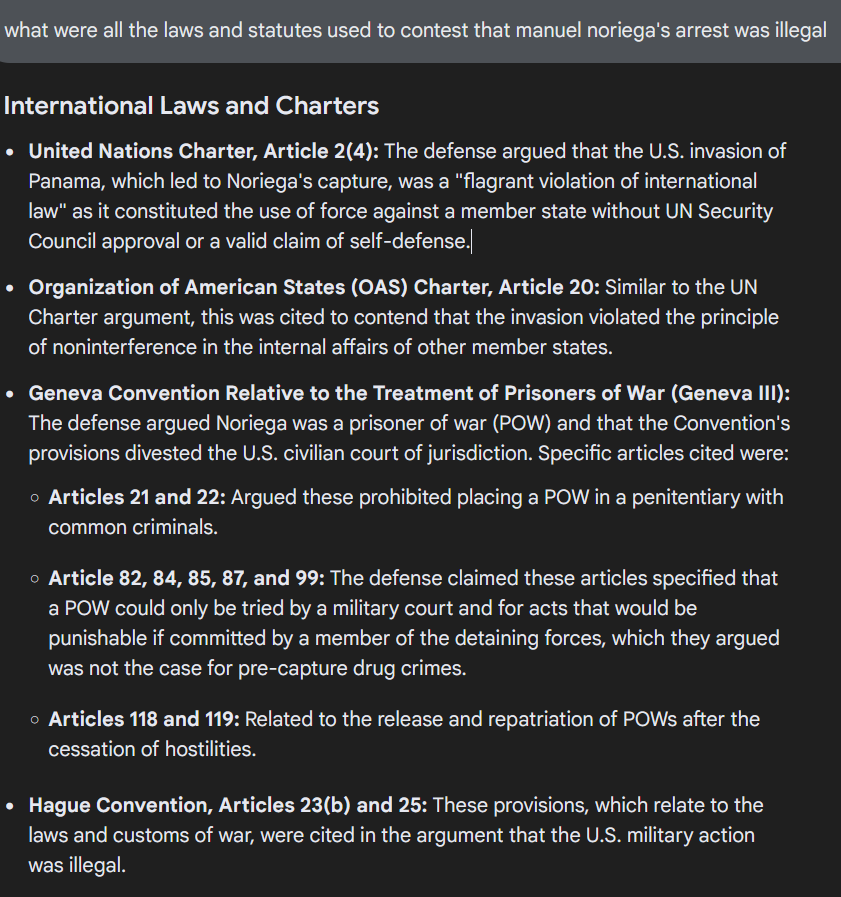
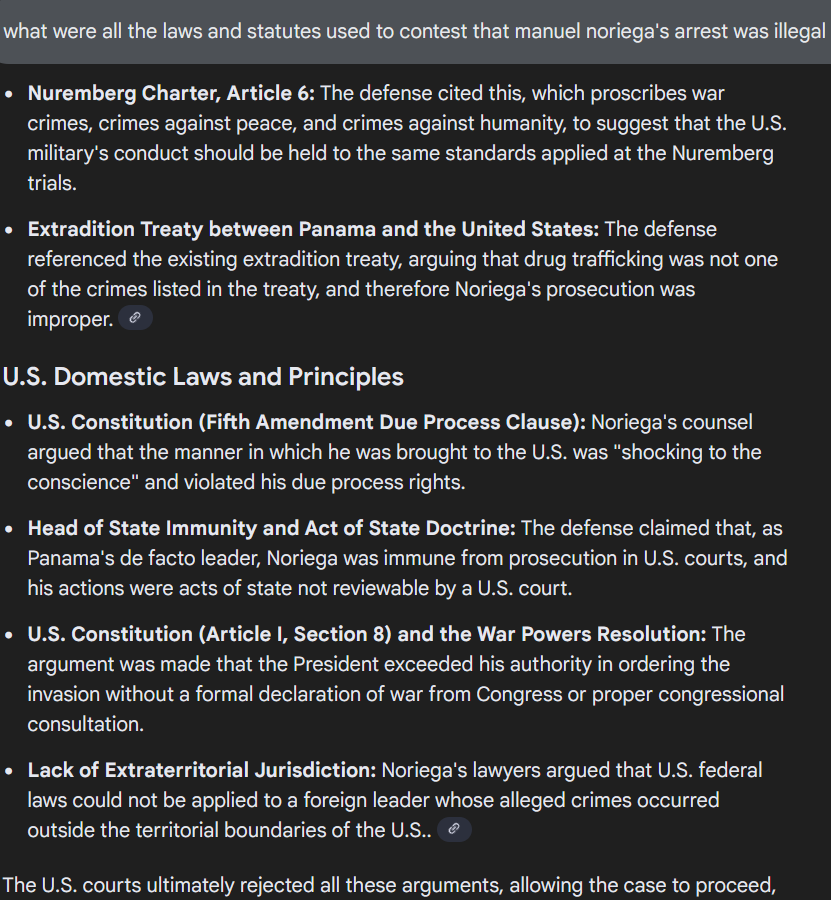
When Manuel Noriega was prosecuted in the U.S., Judge Hoeveler (S.D. Fla.) and later the Eleventh Circuit, the court dismissed that the U.S. invasion of Panama, the abduction/forcible seizure of Noriega and the removal of a sitting head of state could have violated international law, including Article 2(4) of the U.N. Charter in terms of Panama’s territorial sovereignty and customary rules limiting armed intervention. Judge Hoeveler asserted that even though his apprehension raised important questions of international law, that did not give Noriega a personal due process right to dismissal of charges, because the U.N. Charter is an agreement between states, giving no private standing to defendants in criminal cases, ruling that only Panama (the injured state) could complain in the proper international forum (i.e., the ICJ). The judge stated, “Noriega must therefore establish that the treaty in question is self-executing in the sense that it confers individual rights upon citizens of the signatory nations, and that it by its terms expresses ‘a self-imposed limitation on the jurisdiction of the United States and hence on its courts.’ United States v. Postal, supra. As a general principle of international law, individuals have no standing to challenge violations of international treaties in the absence of a protest by the sovereign involved.” (Obviously there was no complaint from the Panamanian leadership the U.S. had installed upon invasion.) This was used to dismiss violation of the U.N. Charter, the OAS Charter, the Hague Convention, Geneva Convention I, and the Nuremberg Charter. The judge ruled that since Noriega had never been recognized as Panama’s head of state by the United States, he had no statutory immunity as a head of state, necessary because a serving head of state has personal immunity from the criminal jurisdiction of other countries for any crime, regardless of its gravity. A pretension of having a unilateral capacity to dismiss this was pure legal fiction, but Noriega muddied these waters himself by refusing to honor the prior election. To avoid that the prosecution of the invasion of Panama to arrest Noriega would have been illegal, the judge cited the “Independent Commission of Inquiry on the U.S. Invasion of Panama, [which made no mention of obtaining his arrest as a reason for the invasion] to underscore the fact that no evidence has been presented which suggests that military troops were sent into Panama for the singular or even primary purpose of enforcing U.S. narcotics laws by bringing a suspected drug dealer to trial.” (Apart from say, G.H.W. Bush himself (24:02) repeatedly on television, and his official statement of the purposes for the invasion released by the White House on Jan. 2rd, 1990 (documented further down). In his address to the nation Bush said the invasion would “bring Noriega to justice”, cleverly separating this from his stated purpose of addressing narcotics trafficking. He also said there would be a Panamanian administrator of the canal, which was what the U.S. had attempted to renege on transitioning prior, stating renewed abidance to the Panama Canal Treaty.) On the questionable nature of the invasion, the court excused itself from jurisdiction stating that “broad challenges to an Executive’s conduct of foreign policy are nonjusticiable since the formulation and execution of foreign policy are constitutionally committed to the executive and legislative branches.”
(If you are wondering why this ruling didn’t bring into play the ICJ, the principal judicial organ of the United Nations (U.N. Charter Article 92), beholden to the U.N. Charter (Article 94), which deals with state responsibility and disputes, in the 1986 ICJ case of Nicaragua v. United States, after the ICJ ruled in Nicaragua’s favor (including the CIA’s mining of Nicaraguan harbors), the U.S. rejected the court’s judgment and withdrew from the court’s compulsory jurisdiction, arguing that it was not bound by the ICJ’s decision due to its lack of consent to the court’s jurisdiction, even though the case had already been adjudicated. Article 36 of the ICJ Statute annex to the U.N. Charter allows states to withdraw from the ICJ’s jurisdiction at any time.)
The U.S. court enforced Noriega’s (illegal by their own ratified statutes) apprehension using the Ker-Frisbie doctrine, which is non-statutory. The Ker-Frisbie doctrine was a series of rulings permitting illegal kidnapping as apprehension reaching back to the prosecution of a foreign national forcibly abducted from Peru (Ker v. Illinois, 119 U.S. 436 (1886)), a second ruling that such kidnapping could violate U.S. federal law and still be prosecuted (Frisbie v. Collins, 342 U.S. 519 (1952)), with the Supreme Court ruling that even the illegal kidnapping of a defendant from Mexico by DEA contracted agents (United States v. Alvarez-Machain, 504 U.S. 655 (1992)) did not bar prosecution absent an extradition treaty clause expressly prohibiting abduction. It was ruled that under the Ker-Frisbie doctrine, unless the arrest involves “torture, shocking conduct, or conduct intended to undermine judicial integrity”, the defendant could not suppress jurisdiction even if seized illegally. So a doctrine that holds that U.S. courts have prosecutorial jurisdiction even if a prisoner was illegally obtained internationally was used to violate the U.N. Charter and international law. (None of this gives the U.S. the right to invade a country.)
Jurisdiction was asserted over Noriega’s actions based on “protective principle” as “customary international law”, which is not enacted by a legislature and not codified in a statute. It allows a state to prosecute a non-national’s acts committed abroad if they have a “direct effect” within that state’s borders, if the conduct abroad threatens the nation’s security or governmental functions, stating that trafficking large quantities of cocaine into the United States plainly qualified (U.S. v. Noriega, 746 F. Supp. at 1521). Protective principle applies to serious threats to state security or core governmental functions with respects to currency integrity, immigration/border functions, counterintelligence/espionage, national security, terrorism, and large-scale international narcotics trafficking. Doctrinal case law is judicial interpretation that is interpretive and cannot break statutory law, which here it plainly did, meaning protective principal granted that the U.S. could have legally taken Noriega into custody had the Panamanian government authorized U.S. forces to do so, (which they relied on subsequently in prosecution, asserting the Panamanian government put in place by the invasion supported his prosecution, which did nothing to legalize the invasion to arrest him).
Once they had him, the U.S. Justice Department was obliged to assert that the Posse Comitatus Act, which prohibits the use of military force for domestic law enforcement, did not apply internationally.
Given the U.S. violated its own laws to get him, the pretext that the Panama invasion was to apprehend Noriega is only the vantage of hindsight, because part of the run up to the war was indicting Noriega as a narco-trafficker, “the first time a foreign head of state had ever been indicted in the United States”. (23:30) When Rubio tweeted this to Maduro as a threat, it wasn’t just red meat for the base, he was flaunting the U.S. as a rogue state on the world stage, breaking its own statutes in violation of the laws of armed conflict, engaging in an illegal apprehension with attendant war crimes, ridding themselves of a now discomfiting former CIA asset heavily involved in the Contra affair (this provides a summary but ABC lies twice: the Panama Canal Zone was not considered U.S. territory post 1979, nor was it ever anything other than a territorial administration of the canal, and the implication there was Russian interference in the 2016 election is false). With respects to the Iran-Contra scandal, Bush’s invasion was wiping out a witness to the chain of actions of individuals he proceeded to pardon (Archive), sealing the cover-up. (Elliott Abrams was of course one of these, and the independent counsel for the Iran-Contra investigation declared that Reagan and Bush himself had been protected by Bush’s action, as it prevented prosecutions.) Given Bush was implicated in knowledge of Noriega’s drug activities as a CIA asset, it wasn’t difficult to prosecute.
The more likely cause for the invasion was because by the terms of the Panama Canal Treaty of 1977 (also known as the Torrijos-Carter Treaty), the US agreed to give up its fourteen military bases (including the headquarters for its Southern Command) in charge of maintaining the neutrality of the Canal Zone (territory which was only ever administered and was already ceded by the U.S. in terms of civil administration in accordance with the treaty in 1979), by noon on December 1st, 1999 (Panama time). “In March 1991, President Guillermo Endara proposed a constitutional amendment that would forever abolish Panama’s right to have an army.” (1:27:37) In the same year, “U.S. Congress passed a law to ensure U.S. military presence in Panama, on the grounds that Panama was no longer capable of defending the canal”. This was a “sense of Congress” provision, which is a non-binding statement of opinion, and ultimately negotiations to retain U.S. military bases in Panama after 1999 failed. As of 1994 and presently, Panama still has no army.
According to Ved P. Nanda, “President Bush declared that he had accomplished all four objectives for which he had ordered U.S. troops to Panama. These were: ‘To safeguard the lives of American citizens, to help restore democracy, to protect the integrity of the Panama Canal Treaties, and to bring Noriega to justice’ [...] and [he] said that the United States had ‘used its resources in a manner consistent with political, diplomatic and moral principles’.” As noted by Nanda, “legal” was not among those principles. Only the first could have possibly provided a pretext for war, more than highly questionable because the Panama Defense Force (PDF) had not engaged in a military attack on any U.S. military installations. Having this aggregate of reasons (the first being American lives) didn’t increase validation legally. For all of these issues, then as now, a military invasion is an overwhelmingly disproportionate use of force (proportionality also being enshrined in the laws of war). It wasn’t legal, then as now. Neither will the use of military force be legal to “regain” the Panama canal.
You’ll note G.H.W. Bush did not cite, as his administration (and the judge) bandied about as a damning indictment, that on December 15th 1989 the National Assembly of Panama adopted a resolution stating that Panama and the United States were in a state of war, because it was not a declaration of war. Rather it resolved that because of the constant state of aggression caused by escalating U.S. sanctions, U.S. refusal to honor the Panama Canal Treaty, two coup attempts blamed on U.S. assistance or incitement (one CIA operation based out of Costa Rica (p.4) and one U.S. Army forces orchestrated with elements of the PDF that they deliberately reneged on (28:20)), -plus U.S. military preparation and drilling exercises which took place on Panamanian soil in the summer of 1989, U.S. actions against Panama had put it into a state of war. If it had been a declaration of war, an assault on U.S. military installations would have followed. Only one party was in drill preparations for a war, and that party invaded December 20th, 1989.
The invasion also was (just as the attack on Venezuelan and other OAS seagoing nationals is) a violation of the Charter of the Organization of American States (OAS), Articles 3, 19, 21 and 22, an international treaty the U.S. has signed and ratified, making it part of the body of international law that governs the country. Articles 19 and 21 enshrine state sovereignty from military intervention or occupation for any reason, 22 permits military aggression only as a matter of self defense, and 3 enshrines abidance by international law. (The reason this does not match the citation in the Noriega case is because of a subsequent amendment to the OAS Charter.)
With respect to U.S. domestic law, the US government claimed legal justification for the invasion of Panama under President Bush’s constitutional authority in Article II as Commander-in-Chief, authorized within the time frame of the War Powers Resolution with only five days of combat, and claiming his notification of Congress of the war the day after the invasion qualified as consultation. The 1973 War Powers Resolution was ratified subsequent to the executive launching the Vietnam War absent congressional declaration of war (to prohibit that and the secret bombing of Cambodia from ever happening again), It was preventative legislation, “designed to reassert Congress’ constitutional role in authorizing military action while regulating the president’s conduct in those circumstances where the Executive claims constitutional authority to introduce U.S. forces into hostilities”, but gave the President legal latitude to unilaterally initiate war on the grounds of self defense, provided the military endeavor of combat duration is less than 60 days (unless authorized for extension by Congress). Self-defense grounds authorize the Commander in Chief to act without a Congressional declaration of war if the U.S. is militarily attacked too suddenly for Congress to convene and declare war, in this instance citing the need to protect US personnel/civilians and to protect the Panama Canal under the Torrijos-Carter Treaty (which the U.S., not Panama, had attempted to violate, and which included direct protections of Panamanian sovereignty from the U.S. which they violated; there is a second treaty to preserve the canal’s neutrality). The arrest of Noriega was inapplicable from a domestic legal standpoint (it was so illegal as an invasion pretext in terms of international law that this had to be explicitly denied in his prosecution), why it is only the benefit of hindsight.
President Maduro is the second time for this gambit. The U.S. orchestrated string of coup attempts and machinations against Venezuela is long, going back to a coup attempt on Hugo Chavez in April 2002 (plus the failed 2020 attempt under Trump to oust Maduro), a history that makes it inarguable that the only reason for launching drug charges against Maduro is to at long last achieve regime change. The bounty on Maduro has up-ticked past inflation to $50 million (to give a sense of the disproportion, it’s the same sum put on Osama bin Laden; the U.S. put a $1 million bounty on Noriega as well post invasion to eventuate his capture). There are added flourishes. There has been the fake declaration of opposition leader Juan Guaido as interim president (January 23, 2019-January 5, 2023), to deliberately muddy the waters as per Maduro’s legal status as head of state. It was also used to quash Venezuela’s GATT panel dispute citing that U.S. unilateral sanctions violated the legally binding multilateral trade treaty; the purported U.S. violations of the WTO trade agreement were never reviewed.
(It was also used in the expropriation process of Citgo. Welcome to Zio-cronyism. According to The American Prospect, “Last week, a federal judge approved the sale of Venezuelan-owned oil refiner Citgo to Elliott Investment Management, whose founder Paul Singer has been a Rubio backer for a decade.” A true vulture to whom Rubio had proven excessive loyalty, he’d have preferred Rubio for president as a superior Zionist shill (Larry Ellison likewise chose Rubio in 2016) and a better neocon war hawk. (Rubio intervened to personally sabotage Trump’s current peace negotiations between Russia and Ukraine.) The Ellison-Blair TBI connection connects Rubio to the neo-colonial technocratic project that Gaza is set to become (with Trump overseeing Gaza as the head of the Board of Peace). Ellison backed both. (Trump was not joking.))
Maduro’s last election was also broadly contested, but the political opposition source for this allegation did not submit her independent vote findings to the Venezuelan Electoral Branch of the Supreme Court (TSJ), and an independent investigation found widespread irregularities in the digitally uploaded “electoral documents” on her website of counter election results. (The Carter Center confirmed the opposition’s numbers.) Marina Corina Machado is openly engaged in sedition against her own country by publicly appealing for support and military intervention to effect regime change, praising Trump’s illegal engagement against Venezuela as “help” removing Maduro she exhorts Trump must increase, and supports the extrajudicial murder of her own fellow citizens as “saving lives“, putting all blame on Maduro. She’s hedging awfully close to treason if U.S. military engagement for this express goal transpires, with members of her opposition in contact with “senior Trump administration officials to discuss how to choreograph Maduro’s downfall” (and Machado herself in direct contact with Secretary of State/interim National Security Advisor Marco Rubio), as well as offering a contingent bribe appeal to the U.S., pledging $1.7 trillion in Venezuelan resource assets for foreign multinational corporate privatization. She also sought support to advance the dismantling of the “criminal” Venezuelan regime in a 2018 letter to Israeli Prime Minister Netanyahu (serially engaging him after he was put under an arrest warrant by the ICC for war crimes).
Machado was disqualified “from holding any public office for fifteen years [by the Venezuelan Supreme Court,] basing their decision on a 2021 ruling which found [her] guilty of embezzlement. The court found that [she] was part of several corruption scandals involving the opposition, including the alleged pilfering of four billion dollars and damages to the public healthcare system by blocking medicines for HIV and diabetes. In June 2023 Machado was also barred from running for public office by a Maduro-aligned office that accused her of tax fraud.” (In other words, this is not remotely comparable to the violent rejection of the election results that occurred months prior to the invasion of Panama under Noriega.)
The escalating sanctions regime has been far more drastic and far more prolonged, as well as unilaterally illegal (e.g., U.N. Charter Articles 39, 41 enshrine this latitude as UN Security Council discretion, OAS Articles 19, 20, WTO GATT, international human rights standards violated by disproportionate harm to civilians). The sanctions regime was potentially responsible for 40,000 excess deaths in 2017-2018 (war time civilian casualty levels), as well as being the cause (though not the sole cause regionally) of massive out migration (22.5% of Venezuela’s population). The Trump administration celebrated (PDF file) the economic collapse of Venezuela as consequent of U.S. unilateral sanctions:
“The State Department’s fact sheet even frames recent decisions by the Organization of American States, Lima Group, Inter-American Development Bank, and European Union to either recognize or support Guaido’s shadow administration as a U.S. achievement, highlighting Washington’s outsized influence within each of these supposedly international governing bodies. The decision to mention the E.U. and Lima Group is particularly noteworthy considering the United States is not a member of either organization.”
Contrary to its covert employ, the CIA has been openly directed by Trump in a presidential finding to conduct lethal covert operations against the Maduro government. (The source for “lethal” latitude was the New York Times (Archive, not once, but twice).) Announcing this as a threat or coercion (let alone action) is illegal under international law (UN Article 2(4) and OAS Articles 19, 20). Trump hedged on whether this lethal directive encompassed “tak[ing] out” Maduro for the same reason, subsequently affirming his days were numbered. (3:43) At present, President Trump is not citing Maduro’s extradition as a cause for the use of military force (Archive): “I authorized for two reasons, really. No. 1, they have emptied their prisons into the United States of America, and the other thing, the drugs, we have a lot of drugs coming in from Venezuela, and a lot of the Venezuelan drugs come in through the sea.” Not only do these reasons in no way constitute military attacks, the U.S. is culpable for both issues due to the onus to protect its own border; the accusations Venezuela emptied its prisons and is heavily responsible for drug trafficking with a narco-trafficker leader are blatantly false, as will be explained in our continued examination of how truly mask off this is, starting with the following:
“U.S. intelligence has assessed that little to none of the fentanyl trafficked to the United States is being produced in Venezuela, despite recent claims from the Trump administration, a senior U.S. official directly familiar with the matter tells Drop Site.
The official noted that many of the boats targeted for strikes by the Trump administration do not even have the requisite gasoline or motor capacity to reach U.S. waters, dramatically undercutting claims by Secretary of Defense Pete Hegseth. The claim is backed up by recent comments made by Sen. Rand Paul, R-Ky., who similarly noted that zero fentanyl is produced in Venezuela.”
We will unpack this and more with Part 2, including an examination of the corruption and falsehoods used in the manufacture of consent via the weaponized displacement of grievance over the three wave domestic opioid crisis.